28 8 月, 2026
When You Buy a Special Vehicle, Why Choose Suizhou
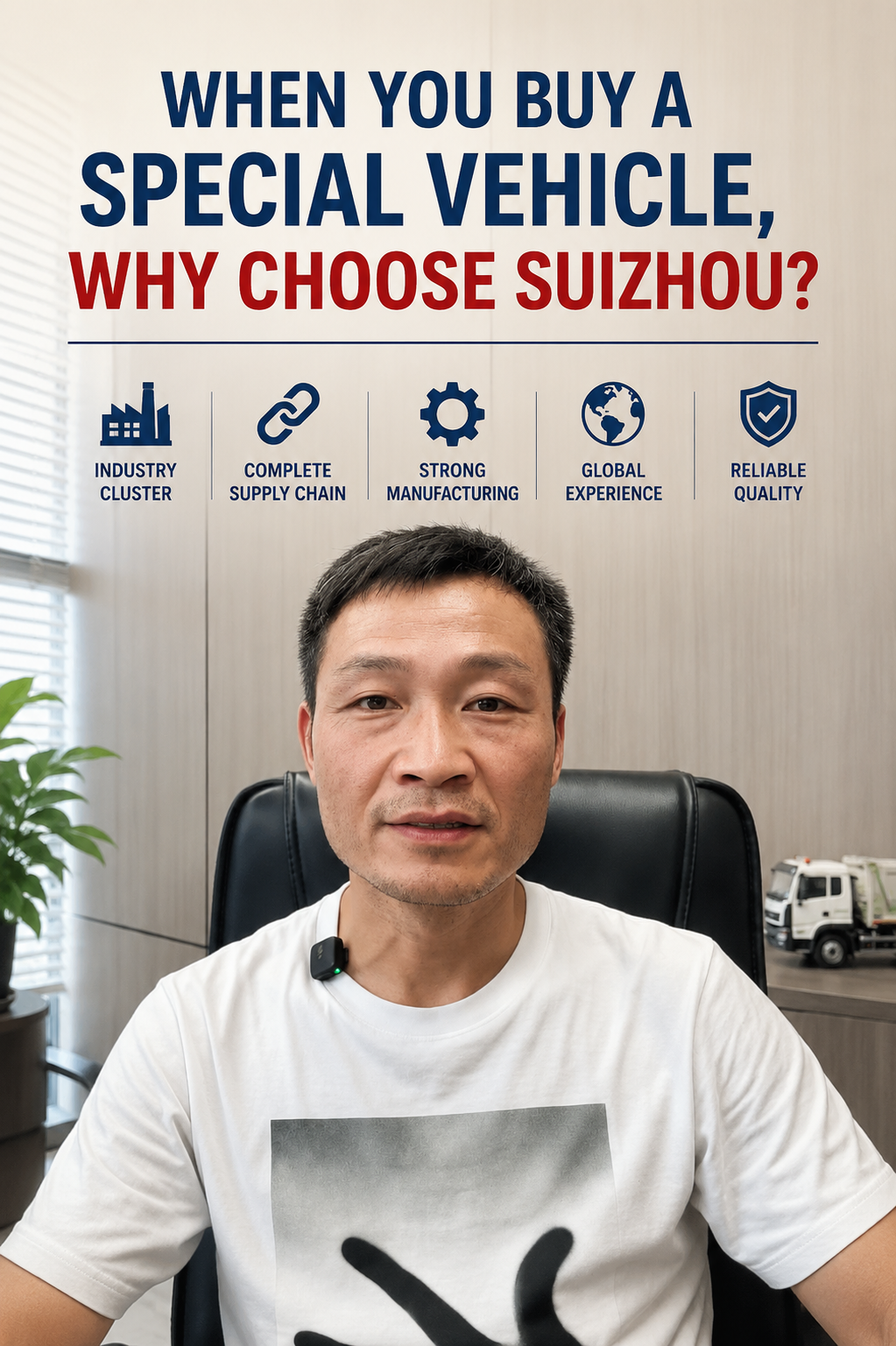
China’s Special Vehicle Capital
When the world needs a special vehicle — a fire truck, a fuel tanker, a sanitation truck, or a construction vehicle — the supply chain often traces back to one place in central China: Suizhou, Hubei Province. Recognized by China’s automotive industry as the Capital of Special Vehicles, Suizhou has built an industrial ecosystem where over 200 manufacturers produce more than 150,000 specialized vehicles each year, in over 300 customizable models.
One Corridor, Complete Supply Chain
What sets Suizhou apart is not just the number of factories — it is how close they are to each other. Along a single 30-kilometer industrial corridor, you can find every component a special vehicle needs: chassis suppliers, tank fabrication shops, hydraulic system manufacturers, pump and valve makers, electronic control integrators, and testing facilities. This cluster density means faster build cycles, lower logistics costs, and tighter quality control at every stage of production.
Instead of sourcing parts from five provinces and waiting weeks for coordination, a manufacturer in Suizhou can complete chassis-body integration, system testing, and final inspection within the same industrial zone — often within a 30-minute drive.
300+ Vehicle Types, Fully Customizable
Suizhou’s manufacturing base covers six major categories of special vehicles:
- Emergency & Rescue Vehicles — fire trucks, ambulances, recovery vehicles, traffic management units
- Tanker & Transport Vehicles — fuel tankers, chemical liquid carriers, LPG/LNG transporters, water trucks
- Construction & Engineering — concrete mixer trucks, pump trucks, dump trucks, crane trucks, aerial platform vehicles
- Municipal Sanitation — garbage collection trucks, street sweepers, sewage suction trucks, road washing vehicles
- Logistics & Cargo — refrigerated trucks, box trucks, flatbed trailers, container carriers
- Special Platform Vehicles — mobile power stations, broadcast vehicles, laboratory trucks, military-spec transports
Within each category, specifications can be tailored: chassis brand (Dongfeng, Sinotruk, Foton, JAC, Shacman, etc.), tank capacity, pump type, body material (carbon steel, stainless steel, aluminum alloy), emission standard, and cabin configuration. If a buyer needs a 15,000-liter aluminum fuel tanker with a Dongfeng 6×4 chassis and a top-loading system, Suizhou can build it.
Quality Standards and Certifications
Manufacturing scale means nothing without quality assurance. Suizhou’s special vehicle industry operates under China’s CCC (China Compulsory Certification) framework, with additional compliance for international standards:
- CCC Certification — mandatory for all special vehicle types sold in or exported from China
- Emission Standards — Euro 5 and Euro 6 engine options available for export markets
- ISO 9001 — most major manufacturers hold quality management system certification
- Third-Party Inspection — pre-shipment inspection by SGS, BV, or TUV is standard practice for export orders
- Pressure Vessel Certification — required and maintained for all tanker-type vehicles
Global Export Experience
Suizhou’s special vehicles are not new to international markets. Over the past decade, manufacturers here have exported to Southeast Asia (Philippines, Vietnam, Thailand, Myanmar), the Middle East (UAE, Saudi Arabia, Iraq, Jordan), Africa (Nigeria, Kenya, Ghana, Algeria), and South America (Peru, Chile, Bolivia).
This export experience means the supply chain understands the practical requirements of international trade: right-hand drive configurations, tropical climate adaptations (corrosion-resistant coatings, reinforced cooling systems), desert-duty specifications (enhanced air filtration, higher temperature tolerances), and compliance with destination-country certification schemes such as SONCAP (Nigeria), BPS (Philippines), and GSO (Gulf Cooperation Council).
Cost Advantage of Cluster Manufacturing
Why does sourcing from Suizhou cost less than sourcing from scattered suppliers across multiple provinces? The answer is cluster economics:
- Logistics savings — components travel kilometers, not hundreds of kilometers, reducing freight and damage risk
- Coordination efficiency — face-to-face technical meetings between chassis, body, and system suppliers happen same-day
- Competitive pricing — with 200+ manufacturers in one corridor, market competition drives fair pricing
- Faster turnaround — integrated production lines mean a 30-45 day build cycle for most custom orders, compared to 60-90 days in fragmented supply chains
- Lower MOQ barriers — small-batch and single-unit custom builds are economically feasible
The Bottom Line
When you buy a special vehicle, the choice of origin matters. Suizhou’s combination of industrial scale, supply chain density, manufacturing flexibility, quality assurance, and export experience makes it the most efficient sourcing destination for special vehicles in China. Whether you need one fire truck or a fleet of fuel tankers, the answer to “Why Suizhou?” is simple: no other place in China can build it faster, customize it better, and deliver it at a better value.
That is not a marketing claim — it is the result of 30 years of industrial clustering, government investment, and supply chain evolution in one city.
Learn more about Suizhou’s special vehicle industry and how to source the right vehicle for your needs. The infrastructure, the expertise, and the manufacturing capacity are already here.